AMZN_Banner

Showing posts with label archetype. Show all posts

Thursday, September 15, 2016

Trade Wizard (Arcanist and Wizard Archetype)

Greetings Faithful Readers,

If we have been wondering where we haven't been posting the past few months, I will tell you. I lost my job. And while that would seem to make more time for writing and posting blog posts, it actually turns your schedule into a maelstrom of chaos. Anyways, my co-conspirator, Adam, kept bugging me to get my act together, and now weekly or every-other-week blog posts will resume. Thank you for your patience.

Sincerely,
Tim Wallace

Illustration by NathanParkArt and used under the Creative Commons Attribution-
Noncommercial-No Derivative Works 3.0 License. (original image)
Trade Wizard
by Adam Frank and Tim Wallace

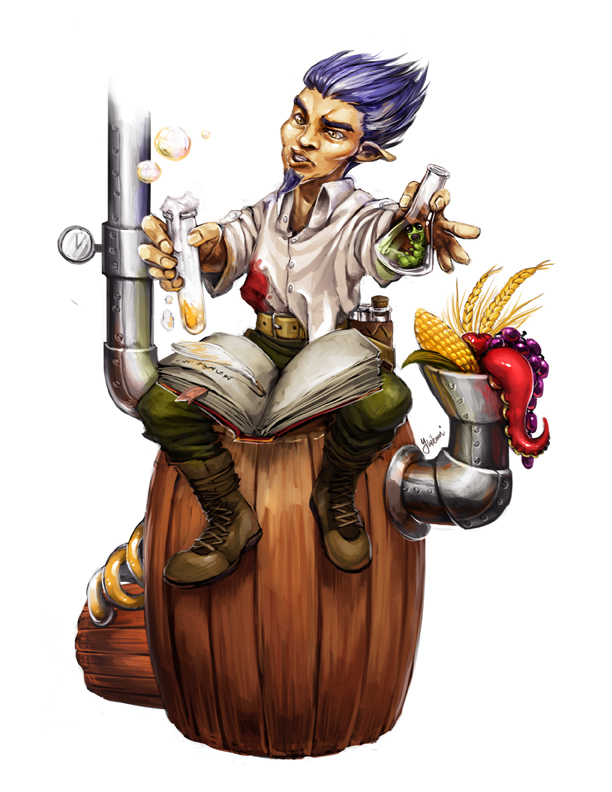
Covered in various powders, oils, and inks, the Trade Wizard is a master craftsman. While many magic users are able to create the mystic from the mundane, the Trade Wizard has honed their crafting to an art form. They specialize in outfitting themselves and others for the various trials of adventuring. It is often said that a Trade Wizard is never caught unaware and this has certainly proven to be true. The knapsack of a Trade Wizard, while often a powerful magical dweomer in itself, holds countless mysteries of the arcane ready to help the arcanist out in a heartbeat.
Some Trade Wizards prefer to settle down and create a shop of magical wares and goods. These individuals are known for taking old junk like worn out boots, rusty old swords, or well-worn armors and breathing new life into them. They will buy items from almost anyone and turn around to sell it back with some new enchantment or another, always turning a tidy profit.
Always willing to bark their wares, the Trade Wizard is constantly carrying a plethora of scrolls and potions for various occasions and are always willing to help someone in need for the right price. A Trade Wizard seems to always show up at the right time to offer a magical solution to a problem, should one arise. 

Trade Wizard (Arcanist or Wizard)
While oftentimes underappreciated, the Trade Wizard can be useful anywhere and at any time due to how prepared they tend to be. They have created both some truly wondrous items and some terrifying cursed charms. It is said even that some of the most powerful Trade Wizards can store pieces of their souls in the wonders they craft, imbuing them with sentience.
Bonus Feat: At 1st, 9th (or 10th level if she is a wizard), and 15th level, a trade wizard gains a bonus item creation feat from the following list: Brew Potion, Craft Magical Arms and Armor, Craft Wand, Craft Wondrous Item, or Scribe Scroll. At 9th level, the following feats are added to the list: Craft Rod, Craft Staff, and Forge Ring. A trade wizard need not have any of the prerequisites normally required for these feats to select them. This replaces the arcanist exploits gained at 1st, 9th, and 15th levels for an arcanist, or the Scribe Scroll feat and the bonus feats gained at 10th and 15th levels for a wizard.
Master Artificer: At 5th level, a trade wizard receives a +2 bonus on Spellcraft checks, and may create magical items much more quickly than normal.  Whenever a trade wizard makes magical items using Spellcraft, use the item's gp value as its sp value when determining his progress (do not multiply the item's gp cost by 10 to determine its sp cost). This replaces the arcanist exploit gained at 5th level for an arcanist and the bonus feat gained at 5th level for a wizard.


Thursday, April 7, 2016

Gunmetal Alchemist (Alchemist Archetype)

by Tim Wallace

Here is another (sure-to-be-controversial) alchemist archetype I have created at the bequest of one of my players.

Gunmetal Alchemist (Alchemist Archetype)
Gunmetal alchemy was developed by synthetic races (such as androids and half-constructs) to better utilize the transmutability of their own bodies and the world around them.

Illustration by Cyph1n and used under the Creative Commons Attribution-Noncommercial-No Derivative Works 3.0 License. (original image)
Bombs: A gunmetal alchemist does not receive bombs. The gunmetal alchemist may not select any discoveries that modify bombs. The majority of the gunmetal alchemist’s class abilities replace the alchemist’s normal bomb ability.

Bonus Extracts: At 1st level, a gunmetal alchemist adds the following extracts to his alchemist formulae list at the listed extract level: 1st–mending, 2nd–make whole, masterwork transmutation, soften earth and stone, wood shape, 3rd–stone shape, 4th–greater make whole, 5th–rapid repair, transmute mud to rock, transmute rock to mud, 6th–ironwood, transmute metal to wood.

Close Combat Training: At 1st level, a gunmetal alchemist gains Weapon Group Proficiency with close weapons and one other weapon group of his choice. This replaces the alchemist’s normal weapon proficiencies.

Bonus Feat: At 3rd level, and every 4 levels thereafter, a gunmetal alchemist may select a bonus feat. These feats must be taken from the following list: any style feat, Combat Flexibility, Deflect Arrows, Dodging Mobility, Elemental Fist, Flurry, Greater Flurry, Snatch Arrows, Spring Attack, Stunning Fist, Weapon Group Focus, and Weapon Group Specialization.

Bonus Discovery: At 5th and 13th levels, a gunmetal alchemist may select an additional alchemical discovery. Some discoveries can only be made if the gunmetal alchemist has met certain prerequisites first, such as uncovering other discoveries.

SoulboundAt 9th level, a gunmetal alchemist bind his soul body with an alchemical seal. Creating an alchemical seal costs 5,000 gp and takes 1 week of work. If he dies, he can be resuscitated as long as the seal has not been broken and his body is healed or repaired to 0 hp or more. He can only have on alchemical seal on his body at a time.
If the part of his body the seal is on (head, torso, right arm, right leg, left arm, or left leg)  or a portion of that part of the body (ear, eye, neck, upper arm, hand, et cetera) is the target of a critical called shot of debilitating blow (from the called shot system in Ultimate Combat) or a confirmed critical hit (in my location-based critical hit system), the seal receives the broken condition and is therefore nonfunctional. It must be repaired with a make whole or greater make whole spell or extract to regain functionality.


Thursday, March 31, 2016

Hulking Alchemist (Alchemist Archetype)

by Tim Wallace

Here is a new archetype I created at the bequest of one of my players.

Hulking Alchemist (Alchemist Archetype)
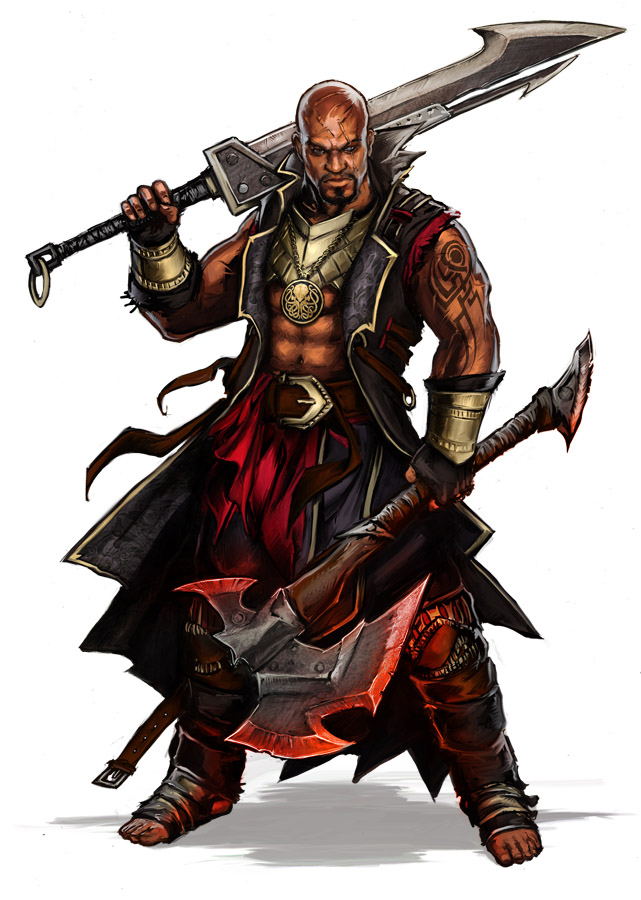
Hulking alchemists have learned how to use their mutagens to unlock the size and abilities of giants.

Jotungrip: At 2nd level, whenever a hulking alchemist creates a mutagen that improves his Strength, he may choose to wield a two-handed weapon in one hand with a –2 penalty on attack rolls while doing so. The weapon must be appropriately sized for him, and it is treated as one-handed when determining the effect of Power Attack, Strength bonus to damage, and the like. This ability replaces poison use.

Jotunform Mutagen: At 3rd level, a hulking alchemist’s mutagen grants him low-light vision causes him to increase in size. This increase changes the creature's size category to the next larger one, which persists as long as the mutagen. A hulking alchemist whose size increases to Large has a space of 10 feet and a natural reach of 10 feet. 

Illustration by Yama Orce and used under the Creative Commons Attribution-
Noncommercial-No Derivative Works 3.0 License. (original image)
All equipment worn or carried by the hulking alchemist is similarly enlarged by the mutagen. Melee weapons affected by the mutagen deal more damage (see Table: Tiny and Large Weapon Damage). Other magical properties are not affected by this spell. Any enlarged item that leaves the hulking alchemist's possession (including a projectile or thrown weapon) instantly returns to its normal size. This means that thrown and projectile weapons deal their normal damage. Magical properties of enlarged items are not increased by this spell.

This ability does not stack with other magical effects that increase size, such as enlarge person. This ability replaces swift alchemy.

Massive Weapons: At 6th level, a hulking alchemist becomes skilled in the use of massive weapons looted from his titanic foes. He can use two-handed weapons meant for creatures one size category larger, but the penalty for doing so is increased by 3. However, the attack roll penalty for using weapons too large for his size is reduced by 1, and this reduction increases by 1 for every three levels beyond 6th (to a minimum of 0). This ability replaces swift poisoning.

Greater Jotunform Mutagen: At 10th level, a hulking alchemist’s mutagen grants him three abilities listed in the giant form I spell, which persist as long as the mutagen. He may select three different abilities each time he creates a mutagen. This ability replaces poison resistance +2, +4, and +6, as well as poison immunity.

Grand Jotunform Mutagen: At 14th level, a hulking alchemist’s mutagen grants him four abilities listed in the giant form II spell, which persist as long as the mutagen. He may select four different abilities each time he creates a mutagen. This ability replaces persistent mutagen.

Illustration by Yuikami and used under the Creative Commons Attribution-
Noncommercial-No Derivative Works 3.0 License. (original image)
Discoveries: The following discoveries complement the hulking alchemist: feral mutagen, grand mutagen, greater mutagen, infuse mutagen, preserve organs.

Wednesday, February 17, 2016

Arcane Trapper (Arcanist Archetype)

by Tim Wallace

Arcane Trapper (Arcanist Archetype)
Unlike other trap “experts,” the arcane trapper has mastered the construction and deconstruction of all traps; mundane, magical, and supernatural.

Class Skills: An arcane trapper adds Disable Device and Perception to her list of class skills in addition to the normal arcanist class skills.

Diminished Spellcasting: An arcane trapper may cast one fewer spell of each level than normal. If this reduces the number to 0, she may cast spells of that level only if her Intelligence allows bonus spells of that level.

Trapfinding: An arcane trapper adds 1/2 her arcanist level on Perception checks made to locate traps and on Disable Device skill checks (minimum +1). An arcane trapper can use Disable Device to disarm magic traps.

Exploits: At 1st level, an arcane trapper can select from the following exploits in addition to the normal arcanist exploits.

Quicken Spell Traps: An arcane trapper with this exploit reduces the casting time of all magical trap spells (such as explosive runes, fire trap, or the various symbol spells) by one step (i.e. a 10  minute casting time becomes 1 minute, a 1 minute casting time becomes 1 round, or a 1 round casting time becomes 1 standard action). This cannot reduce the casting time of a magical trap spell below 1 standard action. The arcanist must have the trap focus or trap study exploit to select this exploit.

Trap Focus: An arcane trapper with this exploit adds +1 to the DC of any magical trap spell (such as explosive runes, fire trap, or the various symbol spells) she casts.

Trap Study: An arcane trapper with this exploit adds the following spells to the list of available spells for her to learn from scrolls or upon leveling up: glyph of warding, greater glyph of warding, and spike stones.

Trap: At 5th level, an arcane trapper learns how to create a snare trap and one other ranger trap of her choice. The arcane trapper counts her total arcanist level as her ranger level for the purpose of determining the effects of her traps. The DCs for Perception checks to notice the trap, Disable Device checks to disable it, and for saving throws to avoid it are equal to 10 + 1/2 the arcane trapper's level + the arcane trapper's Intelligence modifier. At 7th level and every two levels thereafter, she learns another trap. The arcane trapper can use these traps a total number of times per day equal to 1/2 her arcanist level + her Intelligence modifier. Once a trap is learned, it can’t be unlearned and replaced with a different type of trap. The arcane trapper cannot select an individual trap more than once.

Greater Exploits: At 11th level, can select from the following greater exploits in addition to the normal arcanist greater exploits.

Greater Quicken Spell Traps: An arcane trapper with this exploit reduces the casting time of all magical trap spells (such as explosive runes, fire trap, or the various symbol spells) by two steps (i.e. a 10  minute casting time becomes 1 round and a 1 minute casting time becomes 1 standard action). This cannot reduce the casting time of a magical trap spell below 1 standard action. The arcanist must have the quicken spell traps exploit to select this exploit.

Launch Trap: An arcane trapper with this exploit can affix a magical ranger or spell trap to an arrow, crossbow bolt, or thrown weapon, allowing her to set the trap remotely or use it as a direct attack. Attaching the trap to the projectile is part of the full-round action of creating a new ranger trap or the casting time of the spell trap. The trapped projectile is fired or thrown in the normal manner. If fired at a square, the trap is treated as if the ranger had set the trap in that square, except the DC is 5 lower than normal. If fired at a creature, the target takes damage from the ranged weapon and is treated as if it had triggered the trap (saving throw applies, if any). The attack has a maximum range of 60 feet, and range increments apply to the attack roll. The duration of the trapped projectile starts from when it is created, not from when it is used.

List of spell traps.
1st level—alarm, sunder breaker

† spell may only be learned if the arcanist has the trap study arcane exploit.


Tuesday, August 4, 2015

Unearthed Errata: Oathsworn

by Tim Wallace

Here is my conversion of the oathsworn as an archetype for both the core and unchained versions of the monk class. I also created a few new ki powers to mimic a few of the oathsworn class abilities not yet replicated by the unchained monk class.

Ki Powers: The following new ki powers can be taken by any qinggong or unchained monk who meets the prerequisites. Unless otherwise noted, a monk must have attained 4th level to select a ki power below, and a monk cannot select an individual ki power more than once.

Energy Adaptation (Su): A monk with this ki power can spend 1 point from his ki pool as a swift action to gain energy resistance 10 against whichever type of energy he selects: acid, cold, electricity, or fire. Once activated, this ability lasts for 1 minute per monk level. The value of the energy resistance granted increases to 20 points at 7th level, and to a maximum of 30 points at 11th level.
Environmental Adaptation (Ex): As long a monk with this ki power has at least 1 point in his ki pool, he suffers no harm from being in a hot or cold environment, as the endure elements spell.
Planar Adaptation (Su): A monk with this ki power can spend 3 points from his ki pool as a swift action to gain the effects of the planar adaptation spell. Once activated, this ability lasts for 1 minute per monk level. A monk must be at least 12th level and must possess both the energy adaptation and environmental adaption ki powers before selecting this ki power.

Oathsworn (Monk)
Perhaps the most dedicated and steadfast individuals in all the land, oathsworn pick a task and then set out to accomplish it—no matter what stands in their way. Oathsworn are skilled martial artists and unarmed combatants, and their supernatural devotion to their oath allows them to survive in the most hostile environments.

Oath (Su): At 1st level, an oathsworn disciplines his body to hold more ki by swearing to uphold an oath—a very specific task—he will accomplish in no more than one year’s time. Swearing this oath grants the oathsworn an extra 1 ki point for every monk level he possesses. The oathsworn gains this extra ki even before he gains his ki pool at 4th level. If the oathsworn has at least 1 point of ki, he gains a +2 bonus on all Acrobatics, Climb, Escape Artist, Stealth, and Swim. As a swift action, the oathsworn can spend 1 ki point immediately before making an ability or skill check to gain a +4 insight bonus on the check.
Oaths can be singular tasks (destroy the Ebon Pinnacle) or ongoing (keep Suen Ng-hung alive). Ongoing oaths can be renewed at the end of each year. An oath must be something measurable, so the character knows whether it has been fulfilled. If the Ebon Pinnacle still stands after one year, or if Suen Ng-hung dies, the oathsworn who made those oaths clearly failed. If the Ebon Pinnacle lies in ruins or if Suen Ng-hung remains alive at the end of the year (never having died at any point during the year), the oaths were fulfilled and the oathsworn successful.
It is crucial that the player of an oathsworn character work out the details of his oath with the GM. The GM should make sure that the oath does not run counter to the direction of the campaign or prevent the character from taking part in planned adventures.
If the task is not completed within one year, or if conditions arise that indicate the failure of the oath, the oathsworn’s ki pool is reduced to 0 (as if he had spent all of his ki points) and he cannot replenish his pool or use abilities that require ki or a ki pool until he has redeemed himself. Redemption requires he swear an oath again (it can be either the same oath or a new one) accompanied by an atonement spell. After the redemption, the oathsworn’s normal ki pool (without the bonus from the oath or the ability to perform an oath strike) returns. If he upholds the oath for a full month, his ki pool regains the additional points from swearing the oath as well his ability to perform an oath strike.
This ability replaces the bonus feat gained at 1st level, the still mind class feature, and alters the ki pool class feature.

Oath Strike (Su): Starting at 16th level, an oathsworn in an endeavor that directly pertains to the fulfillment of his oath, the oathsworn may perform an oathstrike. Using this ability is a standard action that costs 4 ki points, and the oathsworn must announce his intent to use this ability (and spend the ki points) before making the attack roll. The oath strike is resolved as a touch attack that ignores damage reduction (or hardness, if attacking an object).
If the oathsworn is a core monk, this ability replaces quivering palm. If the oathsworn is an unchained monk, this ability replaces the ki power he would gain at 16th level.


Tuesday, July 28, 2015

Unearthed Errata: Greenbond

by Tim Wallace

The greenbond is another of the Arcana Evolved classes that is already very similar to, and share some features of, an existing Pathfinder RPG class: the druid. Hence, I decided to make it an archetype instead of a new class.

Greenbond (Druid)
To understand the greenbond, one first must understand the Green. The Green is the source of life, fertility, and health. Those learned in the ways of magic often refer to its power as “positive energy,” but greenbonds know it as much more. The Green infuses the world, connecting all living things. It ebbs and flows with the coming and going of life.

Plant Bond (Ex): At 1st level, a greenbond forms a mystic bond with plant life. This bond can take one of two forms. The first grants the greenbond one of the following domains: Growth, Jungle, Plant, or Swamp. When determining the powers and bonus spells granted by this domain, the greenbond's effective cleric level is equal to her druid level. A greenbond who selects this option also receives additional domain spell slots, just like a cleric. She must prepare the spell from her domain in this slot, and this spell cannot be used to cast a spell spontaneously.
The second option is to form a close bond with a plant companion. A greenbond may begin play with any of the plants listed in Plant Companions (see below). This plant is a loyal companion that accompanies the greenbond on her adventures. Except for the companion being a creature of the plant type, drawn from the list of plant companions, this ability otherwise works like the standard druid's animal companion ability. This ability replaces nature bond.

Green Empathy (Ex): At 1st level, a greenbond can improve the attitude of a plant creature. This ability functions just like a Diplomacy check made to improve the attitude of a person. The greenbond rolls 1d20 and adds her druid level and her Charisma modifier to determine the wild empathy check result. The typical wild plant creature has a starting attitude of indifferent.
To use green empathy, the greenbond and the plant creature must be within 30 feet of one another under normal conditions. Generally, influencing a plant creature in this way takes 1 minute but, as with influencing people, it might take more or less time.
A greenbond can also use this ability to influence an animal, but she takes a –4 penalty on the check. This ability replaces wild empathy.

Greenbond Power: At 4th level and every 2 levels thereafter, a greenbond selects a greenbond power. This ability replaces all iterations of wild shape except for wild shape (at will).

Erosion Touch (Su): As a melee touch attack, you can deal 1d6 points of damage per level to objects or constructs. If used against an object in another creature's possession, treat this attack as a sunder combat maneuver. You can use this ability once per day, plus one time per day for every three levels you possess.
Life Leach (Su): You can draw life force from the bodies of enemies and channel it into yourself. As a standard action, you can drain the life essence from one living target within 30 feet. The target takes 1d6 points of damage per two levels you possess (maximum 10d6). You gain temporary hit points equal to the damage you deal. You can't gain more than the target's current hit points + the target's Constitution score (which is enough to kill the subject). The temporary hit points last a number of hours equal to your Wisdom modifier. The target receives a Fortitude save (DC 10 + 1/2 your druid level + your Wisdom modifier) to halve the damage (and the temporary hit points you gain). You may use this ability once per day at 8th level, plus one additional time per day for every 4 levels you possess beyond 8th. You must be at least 8th level before selecting this greenbond power.
Massmorph (Sp): As a full-round action, you can alter the size and health of plant life, as if using plant growth or diminish plants. Alternatively, you can transform one willing non-plant creature per druid level (no two of which can be more than 30 feet apart) as tree shape. You may transform creatures as plant shape I at 15th level, or plant shape II at 20th level. You can transform non-plant creatures using this power once per day. You must be at least 10th level before selecting this greenbond power.
Natural Divination (Ex): By observing and interpreting the flights of birds, you may apply a +10 competence bonus on any one skill check. Alternatively, by charting marks in dirt or stone, or observing the behavior of sand when thrown into the wind, you gain a +4 insight bonus on one initiative check. These bonuses must be used during the next 24 hours and you must declare you are using the bonus before the check or save is made. Making a natural divination takes 10 minutes. You may use natural divination (in any combination) once per day plus one additional time per day for every four druid levels you have attained.
Nature's Intuition (Ex): You have become so attuned to the whispers of the natural world, from the croaking of frogs to the groaning of great boulders, that your surroundings constantly keep you preternaturally aware of danger. You may add your Wisdom modifier, instead of your Dexterity modifier, to your Armor Class and CMD. Any condition that would cause you to lose your Dexterity modifier to your Armor Class instead causes you to lose your Wisdom modifier to your Armor Class.
Rooting (Ex): As a move action, you can extend roots into the ground. Your speed is reduced to 5 feet, but you gain a +4 bonus to natural armor and a +10 bonus to CMD against bull rush, overrun, reposition, and trip maneuvers. You also gain tremorsense 30 feet and fast healing 1. You can use this power for a number of minutes per day equal to your druid level. This duration need not be consecutive, but it must be used in 1-minute increments. You must be at least 16th level before selecting this greenbond power.
Speak with Animals (Ex): Choose a specific kind of animal (eagle, fox, dog, and so on). You gain the ability to converse with that type of animal as if you were under the effects of speak with animals. You gain the ability to communicate with an additional kind of animal for every 4 druid levels you have attained.
Speak with Plants (Ex): You gain the ability to converse plants as if you were under the effects of speak with plants.
Spirit of Nature (Su): When in a natural setting, whenever you are reduced to negative hit points, you automatically stabilize. At 8th level, you gain fast healing 1 for 1d4 rounds whenever you are reduced to negative hit points. At 12th level, the ability works everywhere, even in civilized or wholly artificial realms. At 16th level, you gain fast healing 3 for 1d4 rounds when reduced to negative hit points.
Tanglevine (Sp): As a standard action, you can create a 15-foot-long, animated vine that springs from your hand. This vine lasts for 1 round and can be used to make a single disarm, steal, or trip combat maneuver, using your druid level plus your Wisdom modifier in place of your normal CMB. You can use this power a number of times per day equal to 3 + your Wisdom modifier.
Transcendental Bond (Su): You become so attuned to the common spirit shared by all living things that you can use it to communicate with allies. You may communicate with your allies for a number of rounds per day equal to your druid level as if using telepathic bond. You may designate a number of creatures as your ally equal to your Wisdom modifier. Designating a creature is a standard action that requires a touch. At 12th level, you may use this bond to cast a touch spell on a designated ally once per day.
Undo Artifice (Sp): You gain the ability to reduce a nonliving item to its component parts, essentially erasing the hand of artifice and rendering the item into a pile of raw natural materials. This effect acts as the spell polymorph any object, working on both magical and nonmagical nonliving objects. The duration is always permanent. Unlike polymorph any object, it cannot be used to mimic the effects of other spells. Items subject to this effect receive a Fortitude saving throw (DC 10 + 1/2 your druid level + your Wisdom modifier) to negate the effect. Magic items receive a circumstance bonus on this save equal to +1 for every 5,000 gp in the item's value. You may use undo artifice a number of times per day equal to your Wisdom modifier. You must be at least 12th level before selecting this greenbond power.

Photosynthesis (Ex): At 9th level, you feed upon nature's raw essence. Your need to eat and sleep is reduced as if wearing a ring of sustenance, and you gain a +4 racial bonus on saving throws made against poison and sleep effects. This ability replaces venom immunity.

One with the Green: At 20th level, the greenbond has discovered the intrinsic secrets of life itself, granting her incredible control over her own body. Once per day, she can surround herself with an organic cocoon as a full-round action. While enclosed in the cocoon, she is considered helpless.
Eight hours later, she emerges having changed her type to plant, animal, or humanoid, gaining superficial physical characteristics as appropriate. This change does not alter her Hit Dice, hit points, saving throws, skill points, class skills, or proficiencies. Each time the transformation is made; she is cleansed of all poisons or diseases, is restored to full hit points, and heals all ability damage. She must select a new type every time the transformation is made. This ability replaces wild shape (at will).

Plant Companions
Each plant companion has different starting sizes, speed, attacks, ability scores, and special qualities. All plant attacks are made using the creature's full base attack bonus unless otherwise noted. Plant attacks add the plant's Strength modifier on the damage roll, unless it has only one attack, in which case it adds 1-1/2 times its Strength modifier. Some plant companions have special abilities, such as scent. Plant companions cannot gain armor or weapon proficiency feats, even as they advance in hit dice, and cannot use manufactured weapons at all unless their description says otherwise.
As you gain levels, your plant companion grows in power as well. It gains the same bonuses that are gained by animal companions. Each plant companion gains an additional bonus, usually at 4th or 7th level, as listed with each plant choice. Instead of taking the listed benefit at 4th level, you can instead choose to increase the companion's Strength and Constitution by 2.

Carnivorous Flower
Starting Statistics: Size Small; Speed 30 ft., climb 10 ft.; AC +2 natural armor; Attack bite (1d6); Ability Scores Str 10, Dex 17, Con 15, Int 2, Wis 12, Cha 10; Special Qualities low-light vision, scent.
4th-Level Advancement: Size Medium; Attack bite (2d6); Ability Scores Str +4, Dex –2, Con +2; Special Attacks rage (1/day, as the barbarian class feature for 6 rounds).

Crawling Vine
Starting Statistics: Size Medium; Speed 20 ft., climb 20 ft.; AC +2 natural armor; Attack slam (1d4); Ability Scores Str 13, Dex 17, Con 13, Int 1, Wis 12, Cha 2; Special Attacks grab; Special Qualities low-light vision, scent.
4th-Level Advancement: Size Large; AC +1 natural armor; Attack slam (1d6); Ability Scores Str +8, Dex –2, Con +4; Special Attacks constrict 1d6.

Puffball (Floating Fungus)
Starting Statistics: Size Small; Speed 20 ft., fly 60 ft. (average); AC +1 natural armor; Attack thorn (1d4 plus poison); Ability Scores Str 10, Dex 15, Con 12, Int 2, Wis 14, Cha 6; Special Attacks poison (Frequency 1 round [6], Effect 1 Con damage, Cure 1 save, Con-based DC);Special Qualities low-light vision.
4th-Level Advancement: Ability Scores Str +2, Con +2.

Sapling Treant
Starting Statistics: Size Medium; Speed 30 ft., climb 30 ft.; AC +1 natural armor; Attack 2 slams (1d6); Ability Scores Str 15, Dex 10, Con 12, Int 2, Wis 12, Cha 7; Special Qualities double damage against objects, low-light vision.
4th-Level Advancement: Size Large; AC +2 natural armor; Attack 2 slams (1d8); Ability Scores Str +8, Dex –2, Con +4.



Tuesday, June 9, 2015

Unearthed Errata: The Totemic Fury

by Tim Wallace

Woohoo! I’m back! Thank you all for you well wishes. This is my new take on creating a barbarian archetype with the feel of the totem warrior class from Arcana Evolved. I felt my previous attempt, the totem rager, was a bit too complicated. In addition, I decided to make the archetype also available to the bloodrager class from the Advanced Class Guide.

Totemic Fury (Barbarian or Bloodrager)
While all barbarians are known for their ferocity in battle, totemic furies revere a specific totem animal and take on aspects of that animal while raging. A few truly renowned totemic furies form bonds with an animal companion that represents their totem.
Totem Empathy (Ex): At 3rd level, the totemic fury chooses one animal from the hunter's animal focus list. Once selected, this choice cannot be changed. The totemic fury can improve the attitude of animals of the same type as her totem. This ability functions just like a Diplomacy check to improve the attitude of a person. The totemic fury rolls 1d20 and adds her class level and her Charisma modifier to determine the totem empathy check result. The typical domestic animal has a starting attitude of indifferent, while wild animals are usually unfriendly. If the totemic fury is a barbarian, this ability replaces trap sense (or danger sense if she is a Pathfinder Unchained barbarian). If the totemic fury is a bloodrager, this ability replaces blood sanctuary.
Totem Power (Su): At 4th level, the totemic fury gains the following rage power.
Fury of the Beast (Su): The totemic fury gains the animal focus abilities of her totem animal (as the hunter's animal focus ability) while raging or bloodraging. She treats her class level as her hunter level for determining the abilities of the animal focus (such as the improvements gained at 8th and 15th level). If the totemic fury is a barbarian, this ability replaces the rage power gained at 4th level. If the totemic fury is a bloodrager, this ability replaces the bloodline power gained at 4th level.
Totem Companion (Ex): At 5th level, the totemic fury gains the service of an animal companion. This ability functions as the druid's animal companion, using her class level – 4 as her effective druid level. This companion must be an animal associated with her totem (see chart below). Whenever a totemic fury is raging or bloodraging, this animal companion gains a +2 morale bonus to its Strength.  This ability replaces uncanny dodge and improved uncanny dodge for both barbarians and bloodragers.
Totem
Animal Companions
Bat
Bear
Bull
Falcon
Bird (eagle/hawk)
Frog
Monkey
Ape or baboonB2
Mouse
Owl
Bird (owl)
Snake
Stag
AntelopeB3 or elkB3
Tiger
Wolf

Wild Shape (Su): At 6th level, a totemic fury gains the ability to wild shape into the form of a Small or Medium version of her totem animal, as the druid class feature. Her effective druid level for this ability is equal to her class level – 2. She can use this ability twice per day at 12th level, and three times per day at 18th level. This doesn't allow the totemic fury to assume other forms, such as elementals, plants, or other kinds of animals.
When in animal form, the totemic fury loses her ability to speak while in animal form because she is limited to the sounds that a normal, untrained animal can make, but she can communicate normally with other animals of the same type as her totem. The totemic fury uses her class level as her druid level for the purpose of qualifying for feats that affect wild shape (such as Wild Speech). If the totemic fury is a barbarian, this ability replaces the rage power gained at 6th level. If the totemic fury is a bloodrager, this ability replaces the bloodline feat gained at 6th level.
Rage Powers: The following barbarian rage powers complement the totem fury archetype: animal fury, beast totem (lesser, normal, and greater)APG, knockback, knockdownAPG, low-light vision, primal scentUC, scent, sprintUC, and swift foot.